
Community Resources
Community Resources
customElement.about
Community Resources
- Home
- Page Sections Here
In Valley Stream District 30, families are at the heart of everything we do. Research shows children thrive when families are supported, engaged, and included in their education. Our schools do more than teach reading, math, and science, they partner with families to ensure every child has access, opportunity, and a sense of belonging.
Each morning, our principals, school leaders, teachers, and support staff greet families and their children at the door, exchanging updates and sharing in the start of the day. These connections create a welcoming, supportive community where students feel safe, seen, and ready to thrive.
Our Vision & Mission
Our vision is to educate, inspire, and celebrate every child so they reach their full potential as the Global Leaders of Tomorrow. The INSIDE Way, our mission, guides the work of leaders, teachers, staff, and students every day:
- Ignite passion in students
- Nurture their sense of belonging
- Support academic and social-emotional growth
- Integrate best instructional practices
- Differentiate learning
- Empower every child to succeed
Access, opportunity, and belonging guide every decision we make.
Families As Partners
Families remain a key partner in everything we do. When parents attend school events, participate in workshops, and contribute their voices to decision-making, students recognize that their success is a shared commitment. Our schools grow stronger through family engagement, and our community thrives because families understand their role in supporting the next generation.
By partnering with teachers and school leaders, families help ensure every child reaches their full potential and becomes the Global Leaders of Tomorrow they are meant to be.
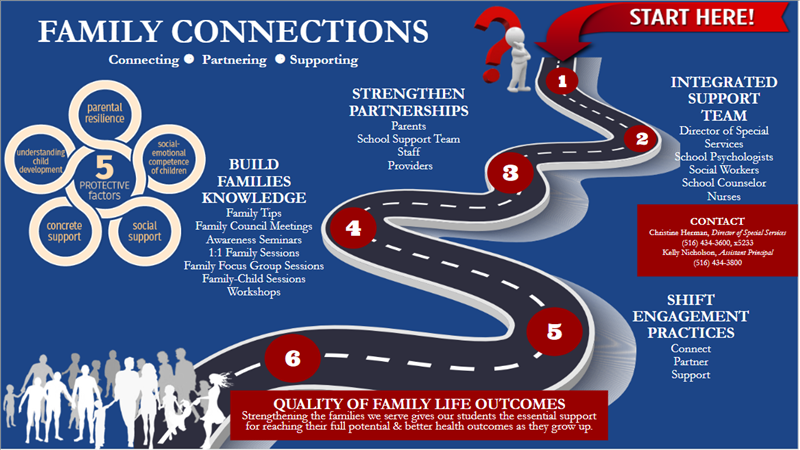
To learn more contact: Ashley Lemmo, Assistant Principal & Social Emotional Learning: +1 (516) 434-3600, Ext. 2231
Welcome to the United States

Welcome to Valley Stream, New York!
The United States Citizenship and Immigration Services provides helpful information about education, child care, employment, what to do in case of an emergency, and a number of popular topics that will help you settle in the United States, check out the links below. (Information provided on the links is available in multiple languages):
- About the United States
- Education and Child Care
- Employment
- Money and Finance
- Emergencies and Safety
- Health Care and Families
- Popular Topics for New Immigrants
- Volunteer in Your Community
As you get settled, we look forward to you becoming involved in your school community and volunteering your time.
Code of Conduct
Our district is committed to providing a safe, orderly, and supportive school environment where children can learn and staff can teach without disruption. The Code of Conduct lays out the expectations that help us protect that environment. The purpose is simple:
- Help every child stay healthy, safe, engaged, supported, and challenged.
- Help children build self discipline and social and emotional skills.
- Help children learn from mistakes in a way that promotes growth.
Everyone who enters our schools has a responsibility to treat others with respect. Children are still developing their judgment, and they will make mistakes. Our role is to guide them, correct behavior when needed, and teach them how to make better choices. A strong school climate is built when children feel connected to adults, have meaningful ways to participate, and are recognized for positive contributions. Leadership opportunities, schoolwide initiatives, and positive behavior systems all play a part. During situations like communicable disease outbreaks, additional health and safety measures may be required, such as distancing or face coverings. The district outlines clear expectations and fair, developmentally appropriate responses when behavior is unsafe or inappropriate. The goal is to teach accountability, not to simply penalize a child. This summary is meant as a quick overview. Families are encouraged to click to read the full policy for all details and procedures.
Student Right and Responsibilities Essential Partners Student Dress Code Prohibited Student Conduct Reporting Violations Disciplinary Penalties Procedures & Referrals Alternative Instruction Discipline of Students with Disabilities Corporal Punishment Student Searches and Interrogations Visitors To The Schools Public Conduct on School Property
Nutrition

Menus, ingredients, and nutrition details are now consolidated on a single webpage. Providing nutritional information, helps our Global Leaders of Tomorrow and their families make healthy choices based on their preferences.
Breakfast Menu Lunch Menu Nutrition Information
Community Eligibility Provision Recipient
All Valley Stream UFSD 30 students will receive a free breakfast and a free lunch each school day of the 2025-2026 school year through the Community Eligibility Provision (CEP).
Although students will receive breakfast and lunch for the 2025-2026 school year at no charge, families are encouraged to continue to fill out the Household Eligibility Form (also know as the Free and Reduced Lunch Application). Families who qualify for free or reduced status may be eligible for additional benefits through New York State such as grocery benefits, P-EBT, discounted utilities and internet access, fee waivers for SAT, ACT, and college applications, textbooks, and many more.
Paper Household Eligibility Form Digital Household Eligibility Form
A La Carte
A la carte items such as water and snacks are NOT ELIGIBLE UNDER CEP and are available for purchase only. These items cannot be charged to a meal account unless there are funds available in the account, or the student has cash/check at the register at time of purchase.

Online School Lunch Payment System
We are pleased to offer an online option to pre-pay for your child's school lunch. mySchoolBucks.com(r) is an on-line system that will allow you to make deposits into your student's school meal accounts using a credit or debit card when it's convenient for you, receive low balance email reminders, monitor your student's account balances online and view your student's cafeteria purchases.
MySchoolBucks Add Your Student FAQ Flyer
Please note: Due to the fact that the P-EBT is a New York State run program, the district does not have any information about payments or eligibility. All questions should be directed to the P-EBT Food Benefits Helpline: 1-833-452-0096
Women, Infant, and Children (WIC) is a special supplemental nutrition program that provides breastfeeding support, nutritious foods, information on healthy eating, and referrals to health care providers to pregnant, postpartum, and breastfeeding women and children up to age five.

The Supplemental Nutrition Assistance Program (SNAP) issues electronic benefits that can be used like cash to purchase food. SNAP helps low-income working people, senior citizens, the disabled and others feed their families. Eligibility and benefit levels are based on household size, income and other factors.

Island Harvest Food Bank is a leading hunger-relief organization with a mission to end hunger and reduce food waste on Long Island. We accomplish this through efficient food and product collection and distribution systems, enhanced hunger awareness and nutrition education programs, a Workforce Skills Development Institute, targeted services for specific populations, outreach activities and advocacy initiatives. If you are in need of food or supplies, please use the interactive map below along with your zip code to find your closest food pantry.
You may also text your zip code to 631-450-3775 to get a list of nearby pantries.
-
Menus, ingredients, and nutrition details are now consolidated on a single webpage. Providing nutritional information, helps our Global Leaders of Tomorrow and their families make healthy choices based on their preferences.
Breakfast Menu Lunch Menu Nutrition Information
Community Eligibility Provision Recipient
All Valley Stream UFSD 30 students will receive a free breakfast and a free lunch each school day of the 2025-2026 school year through the Community Eligibility Provision (CEP).
Although students will receive breakfast and lunch for the 2025-2026 school year at no charge, families are encouraged to continue to fill out the Household Eligibility Form (also know as the Free and Reduced Lunch Application). Families who qualify for free or reduced status may be eligible for additional benefits through New York State such as grocery benefits, P-EBT, discounted utilities and internet access, fee waivers for SAT, ACT, and college applications, textbooks, and many more.
Paper Household Eligibility Form Digital Household Eligibility Form
A La Carte
A la carte items such as water and snacks are NOT ELIGIBLE UNDER CEP and are available for purchase only. These items cannot be charged to a meal account unless there are funds available in the account, or the student has cash/check at the register at time of purchase.
-
Online School Lunch Payment System
We are pleased to offer an online option to pre-pay for your child's school lunch. mySchoolBucks.com(r) is an on-line system that will allow you to make deposits into your student's school meal accounts using a credit or debit card when it's convenient for you, receive low balance email reminders, monitor your student's account balances online and view your student's cafeteria purchases.
MySchoolBucks Add Your Student FAQ Flyer
Please note: Due to the fact that the P-EBT is a New York State run program, the district does not have any information about payments or eligibility. All questions should be directed to the P-EBT Food Benefits Helpline: 1-833-452-0096
-
Women, Infant, and Children (WIC) is a special supplemental nutrition program that provides breastfeeding support, nutritious foods, information on healthy eating, and referrals to health care providers to pregnant, postpartum, and breastfeeding women and children up to age five.
-
The Supplemental Nutrition Assistance Program (SNAP) issues electronic benefits that can be used like cash to purchase food. SNAP helps low-income working people, senior citizens, the disabled and others feed their families. Eligibility and benefit levels are based on household size, income and other factors.
-
Island Harvest Food Bank is a leading hunger-relief organization with a mission to end hunger and reduce food waste on Long Island. We accomplish this through efficient food and product collection and distribution systems, enhanced hunger awareness and nutrition education programs, a Workforce Skills Development Institute, targeted services for specific populations, outreach activities and advocacy initiatives. If you are in need of food or supplies, please use the interactive map below along with your zip code to find your closest food pantry.
You may also text your zip code to 631-450-3775 to get a list of nearby pantries.
Parent Data Dashboard

Your source for information about New York's public schools. The New York State Education Department (NYSED) is committed to making data available and easy to use. This site provides a first step so families can be better informed as they work to advance student achievement. The Parent Dashboard offers information on all public schools including charter schools.
District 30 Data Clear Stream Avenue Data Forest Road Data Shaw Avenue Data
Cultural & Religious Observances Accommodations
- The daily school routine will continue as scheduled, with classroom instruction, lunch, recess, and special programs all at their designated times.
- District policy Student Attendance #5100 states that students may have an excused absence from school for cultural or religious holidays. Families are required to notify the school's main office of the absence.
- If a student is absent and misses a test(s)or a major assignment(s), the teacher will provide an opportunity to make it up.
- Please inform the classroom teacher of any conflicts so accommodations are for your child.
District policy Prayer in School #5040 prevents or denies participation in constitutionally protected prayer in the district's schools, consistent with guidance issued by the United States Secretary of Education and applicable judicial decisions interpreting the religion clauses of the First Amendment of the U.S. Constitution. If your child requires accommodation for prayer, please notify your school principal. School leaders give the same importance when deciding on families' requests, cultural or religious or non-cultural or religious accommodation. Reasonable accommodations are available based on space and supervision, which are often time-limited, making it difficult to provide a separate location for these activities.
Accommodation of Prayer During Instructional Time:
School leaders and classroom teachers make reasonable accommodations for students' religious beliefs and practices while considering the impact on other students during instructional time.
Accommodation of Prayer During Non-Instructional Time:
Students can engage in personal religious (i.e., prayer, meditation, etc.) or non-religious practices during non-instructional time in the same setting and under supervision.
- School leaders make reasonable lunch accommodations for students fasting by creating "fasting" zones in the cafeteria, similar to already established "peanut-free" zones.
- Classroom teachers will attempt to make reasonable snack accommodations within the classroom, such as allowing students to engage in non-instructional activities.
- Teachers are encouraged to avoid scheduling tests or assigning critical assignments due on the day immediately following one of these cultural/religious days of observance, as students may be unable to study or may be affected by fasting or late-night observances.
- School leaders will ensure and encourage special area teachers such as music, art, library, and physical education to make individual accommodations for students on cultural/religious days of observances to ensure students can participate, as students may be affected by fasting or late-night observances.
- School leaders will avoid scheduling school events on cultural/religious days of observance.
- There are times when events or assessments on these days may be necessary and often out of the school’s control.
Please inform your school's principal or your child's classroom teacher if your child will participate in any cultural or religious observances during the academic year. Families must notify school leaders or classroom teachers at least (5) school days before the date of cultural/religious observance. Valley Stream District 30 values open communication and welcomes you to contact us for support regarding specific concerns or needs.
-
- The daily school routine will continue as scheduled, with classroom instruction, lunch, recess, and special programs all at their designated times.
- District policy Student Attendance #5100 states that students may have an excused absence from school for cultural or religious holidays. Families are required to notify the school's main office of the absence.
- If a student is absent and misses a test(s)or a major assignment(s), the teacher will provide an opportunity to make it up.
- Please inform the classroom teacher of any conflicts so accommodations are for your child.
-
District policy Prayer in School #5040 prevents or denies participation in constitutionally protected prayer in the district's schools, consistent with guidance issued by the United States Secretary of Education and applicable judicial decisions interpreting the religion clauses of the First Amendment of the U.S. Constitution. If your child requires accommodation for prayer, please notify your school principal. School leaders give the same importance when deciding on families' requests, cultural or religious or non-cultural or religious accommodation. Reasonable accommodations are available based on space and supervision, which are often time-limited, making it difficult to provide a separate location for these activities.
Accommodation of Prayer During Instructional Time:
School leaders and classroom teachers make reasonable accommodations for students' religious beliefs and practices while considering the impact on other students during instructional time.
Accommodation of Prayer During Non-Instructional Time:
Students can engage in personal religious (i.e., prayer, meditation, etc.) or non-religious practices during non-instructional time in the same setting and under supervision.
-
- School leaders make reasonable lunch accommodations for students fasting by creating "fasting" zones in the cafeteria, similar to already established "peanut-free" zones.
- Classroom teachers will attempt to make reasonable snack accommodations within the classroom, such as allowing students to engage in non-instructional activities.
- Teachers are encouraged to avoid scheduling tests or assigning critical assignments due on the day immediately following one of these cultural/religious days of observance, as students may be unable to study or may be affected by fasting or late-night observances.
- School leaders will ensure and encourage special area teachers such as music, art, library, and physical education to make individual accommodations for students on cultural/religious days of observances to ensure students can participate, as students may be affected by fasting or late-night observances.
-
- School leaders will avoid scheduling school events on cultural/religious days of observance.
- There are times when events or assessments on these days may be necessary and often out of the school’s control.
-
Please inform your school's principal or your child's classroom teacher if your child will participate in any cultural or religious observances during the academic year. Families must notify school leaders or classroom teachers at least (5) school days before the date of cultural/religious observance. Valley Stream District 30 values open communication and welcomes you to contact us for support regarding specific concerns or needs.
School Health
 |
 |
|
|
| Clear Stream School Jeanine Wiese +1 (516) 434-3557 |
Forest Road School Kelly Skliros RN +1 (516) 434-3807 |
Shaw Avenue School Charlena Hamlin-Croutch +1 (516) 434-3707 |
Dr. Ashok Ram
801 Rockaway Avenue |
New immunization requirements for school entrance/attendance went into effect on September 1, 2015 for grades PK to 6.
NY State Immunization Requirements for School Entrance/Attendance
A dental health certificate is recommended for students in Kindergarten and grades 1, 3 and 5. The certificate must contain a report of a comprehensive dental exam.
Physical examinations are required by New York State Law for all new students, in addition to students currently enrolled in PK, K, and grades 1, 3 and 5. Physical examinations must be performed no more than twelve months prior to the start of school. If your child has a physical scheduled during the school year, please notify the School Health Office with the date of the exam. The exam must be submitted on an official NYS Health Examination Form.
To assure the safety of our students while in school and to comply with NYS Health Law mandates, no medications are allowed in school without prior approval. If your child has a condition which requires medication during the school day (including aspirin, ointment, eye or nose drops, as well as prescription medications), the following information must be submitted to the health office, written order from the physician stating:
- Child’s name
- Diagnosis
- Medication
- Frequency of administration
- TIme of administration
- Days to be given
- Possible side effects
The medication must be in the original container and brought to school by an adult.
The medication will be kept locked in the Health Office at all times and dispensed by the School Nurse, according to the Doctor’s written orders.
During the school year, the following screenings will be required or completed at school:
- Vision - Distance acuity for all newly entering students in Pk, K, and grades 1, 3 and 5.
- Hearing - Hearing screening for all newly entering students and students in PK, K, and Grades 1, 3 and 5.
- Scoliosis - Scoliosis (spinal curvature) screening for all girls in grade 5.
A letter will be sent home if your student needs to follow-up with a health care provider. For vision screenings only, parents will be notified of the results. Please call the School Health Office if you have any questions or concerns.
-
Clear Stream School
Jeanine Wiese
+1 (516) 434-3557Forest Road School
Kelly Skliros RN
+1 (516) 434-3807Shaw Avenue School
Charlena Hamlin-Croutch
+1 (516) 434-3707Dr. Ashok Ram 801 Rockaway Avenue
Valley Stream, NY 11581
+1 (516) 825-4151 -
New immunization requirements for school entrance/attendance went into effect on September 1, 2015 for grades PK to 6.
NY State Immunization Requirements for School Entrance/Attendance
-
A dental health certificate is recommended for students in Kindergarten and grades 1, 3 and 5. The certificate must contain a report of a comprehensive dental exam.
-
Physical examinations are required by New York State Law for all new students, in addition to students currently enrolled in PK, K, and grades 1, 3 and 5. Physical examinations must be performed no more than twelve months prior to the start of school. If your child has a physical scheduled during the school year, please notify the School Health Office with the date of the exam. The exam must be submitted on an official NYS Health Examination Form.
-
To assure the safety of our students while in school and to comply with NYS Health Law mandates, no medications are allowed in school without prior approval. If your child has a condition which requires medication during the school day (including aspirin, ointment, eye or nose drops, as well as prescription medications), the following information must be submitted to the health office, written order from the physician stating:
- Child’s name
- Diagnosis
- Medication
- Frequency of administration
- TIme of administration
- Days to be given
- Possible side effects
The medication must be in the original container and brought to school by an adult.
The medication will be kept locked in the Health Office at all times and dispensed by the School Nurse, according to the Doctor’s written orders.
-
During the school year, the following screenings will be required or completed at school:
- Vision - Distance acuity for all newly entering students in Pk, K, and grades 1, 3 and 5.
- Hearing - Hearing screening for all newly entering students and students in PK, K, and Grades 1, 3 and 5.
- Scoliosis - Scoliosis (spinal curvature) screening for all girls in grade 5.
A letter will be sent home if your student needs to follow-up with a health care provider. For vision screenings only, parents will be notified of the results. Please call the School Health Office if you have any questions or concerns.
Activities & Clubs
|
Free Breakfast Meal Each student is entitled to one free breakfast every day that school is in session for the 2025–2026 school year. Breakfast is served in the cafeteria of all three school buildings from 7:45 a.m. to 8:15 a.m. |
Academic Assistance Valley Stream District 30 supports the academic needs of all students. Our teachers provide 35 minutes a week of extra help, either before or after school. Teachers will reach out to inform families of the extra help day and time. In addition, we provide academic support after school for students working toward grade-level standards in our upper grades. This support is provided by teacher recommendation. |

Valley Stream 30 partners with SCOPE to offer 2 after-school programs. Snack is provided in both programs.
|
Enrichment For students in Kindergarten through 6th grade, SCOPE’s enrichment program is offered daily from 3:00-6:00 PM. This program has a fully developed STEAM-based curriculum that is led by a teacher and an instructional support staff member. |
Traditional The second option offered by SCOPE is a traditional aftercare program for students in PreK through 6th grade, which is offered daily from 3:00-6:30 PM. Staff supervise students as they complete homework, engage in art and crafts, and physical education activities. |
Each year, staff have the opportunity to propose clubs they would like to offer to students. Clubs usually begin in early October at each school and provide students with engaging experiences in STEAM, robotics, music, and student leadership.
 |
 |
 |
-

Free Breakfast Meal
Each student is entitled to one free breakfast every day that school is in session for the 2025–2026 school year. Breakfast is served in the cafeteria of all three school buildings from 7:45 a.m. to 8:15 a.m.

Academic Assistance
Valley Stream District 30 supports the academic needs of all students. Our teachers provide 35 minutes a week of extra help, either before or after school. Teachers will reach out to inform families of the extra help day and time. In addition, we provide academic support after school for students working toward grade-level standards in our upper grades. This support is provided by teacher recommendation.
-
Valley Stream 30 partners with SCOPE to offer 2 after-school programs. Snack is provided in both programs.
Enrichment
For students in Kindergarten through 6th grade, SCOPE’s enrichment program is offered daily from 3:00-6:00 PM. This program has a fully developed STEAM-based curriculum that is led by a teacher and an instructional support staff member.
Traditional
The second option offered by SCOPE is a traditional aftercare program for students in PreK through 6th grade, which is offered daily from 3:00-6:30 PM. Staff supervise students as they complete homework, engage in art and crafts, and physical education activities.
-
Each year, staff have the opportunity to propose clubs they would like to offer to students. Clubs usually begin in early October at each school and provide students with engaging experiences in STEAM, robotics, music, and student leadership.
Student Attendance

Regular attendance is one of the most important ways to support your child’s success. Every day in school counts toward learning, building friendships, and staying on track academically.
- Being in school matters. It supports learning, relationships, and opportunities.
- Regular attendance helps staff notice early when a student may be struggling and allows us to step in.
- Absences happen, and we want to partner with families when they do.
- Frequent absences can affect learning and may require support plans to get your child back on track.
- Our goal is to help students reach Level 3 or Level 4 attendance, keeping them engaged and learning every day.
We know life happens, illness, appointments, and family emergencies and we are here to work with you. At the same time, frequent or unexplained absences make it harder for students to succeed and for teachers to teach effectively.
|
Type |
What That Means |
What Families Should Do |
|
Absence |
Absences allowed under policy, including illness, medical/dental appointments, approved religious observances, court appearances, and other reasons approved by the District (including circumstances related to homelessness). |
Notify the school as soon as possible, and provide a written note or documentation when your child returns. |
|
Unexcused Absence |
Tardiness or early departures that do not meet the excused criteria, such as vacation during school days, oversleeping, or non-emergency family commitments. |
Staff will follow up to ensure families understand the policy and offer support if needed. |
Note: Suspensions do not count as absences if the student receives alternate instruction.
NYSED Attendance Levels in Valley Stream UFSD 30
A student is considered chronically absent if they miss 10% or more of school days, including excused, unexcused, or certain disciplinary absences. In District 30, students are expected to attend 181 school days.
|
Attendance Level |
% Days Attended |
Days Missed |
District Support & Family Guidance |
|
Level 1 |
85% or less |
27+ |
Very high absenteeism. Student is at risk academically. District will work closely with family to improve attendance. Immediate support recommended. |
|
Level 2 |
85.1%–90% |
18–26 |
Student is missing significant instruction. Formal interventions may be initiated. NYSED considers 10% or more missed as chronically absent. |
|
Level 3 |
90.1%–95% |
9–17 |
Attendance is generally healthy but missing 1–2 days per month can add up. Families should monitor and prevent absences from increasing. |
|
Level 4 |
95%+ |
0–8 |
Student is consistently present and benefiting fully from instruction. Your child is on track! |
What Happens When Absences Add Up
- Excessive ATEDs: 18 or more days (excused or unexcused).
- Designated staff will contact families, review the policy, discuss the importance of attendance, and develop intervention strategies.
- Students with unexcused ATEDs may face disciplinary actions, such as detention or loss of extracurricular privileges.
- Patterns of absences trigger additional support, and in severe cases, Child Protective Services may be contacted.
Family Tips To Support Good Student Attendance
- Schedule appointments outside school hours when possible.
- Do not plan vacations during school days.
- Communicate early if your child will be absent.
- Keep a calendar of school days and plan around it.
- Reach out to teachers, school psychologists, or social workers if your child is struggling or falling behind.
-
Regular attendance is one of the most important ways to support your child’s success. Every day in school counts toward learning, building friendships, and staying on track academically.
- Being in school matters. It supports learning, relationships, and opportunities.
- Regular attendance helps staff notice early when a student may be struggling and allows us to step in.
- Absences happen, and we want to partner with families when they do.
- Frequent absences can affect learning and may require support plans to get your child back on track.
- Our goal is to help students reach Level 3 or Level 4 attendance, keeping them engaged and learning every day.
We know life happens, illness, appointments, and family emergencies and we are here to work with you. At the same time, frequent or unexplained absences make it harder for students to succeed and for teachers to teach effectively.
-
Type
What That Means
What Families Should Do
Absence
Absences allowed under policy, including illness, medical/dental appointments, approved religious observances, court appearances, and other reasons approved by the District (including circumstances related to homelessness).
Notify the school as soon as possible, and provide a written note or documentation when your child returns.
Unexcused Absence
Tardiness or early departures that do not meet the excused criteria, such as vacation during school days, oversleeping, or non-emergency family commitments.
Staff will follow up to ensure families understand the policy and offer support if needed.
Note: Suspensions do not count as absences if the student receives alternate instruction.NYSED Attendance Levels in Valley Stream UFSD 30
A student is considered chronically absent if they miss 10% or more of school days, including excused, unexcused, or certain disciplinary absences. In District 30, students are expected to attend 181 school days.
Attendance Level
% Days Attended
Days Missed
District Support & Family Guidance
Level 1
Severe85% or less
27+
Very high absenteeism. Student is at risk academically. District will work closely with family to improve attendance. Immediate support recommended.
Level 2
Chronic85.1%–90%
18–26
Student is missing significant instruction. Formal interventions may be initiated. NYSED considers 10% or more missed as chronically absent.
Level 3
Average90.1%–95%
9–17
Attendance is generally healthy but missing 1–2 days per month can add up. Families should monitor and prevent absences from increasing.
Level 4
Excellent95%+
0–8
Student is consistently present and benefiting fully from instruction. Your child is on track!
-
What Happens When Absences Add Up
- Excessive ATEDs: 18 or more days (excused or unexcused).
- Designated staff will contact families, review the policy, discuss the importance of attendance, and develop intervention strategies.
- Students with unexcused ATEDs may face disciplinary actions, such as detention or loss of extracurricular privileges.
- Patterns of absences trigger additional support, and in severe cases, Child Protective Services may be contacted.
Family Tips To Support Good Student Attendance
- Schedule appointments outside school hours when possible.
- Do not plan vacations during school days.
- Communicate early if your child will be absent.
- Keep a calendar of school days and plan around it.
- Reach out to teachers, school psychologists, or social workers if your child is struggling or falling behind.
-
Arrival & Dismissal
School Hours For All Schools
8:15 AM to 2:50 PM
District & School Safety Measures
- School leaders, teachers, and staff share arrival and dismissal procedures with families throughout the year.
- Families receive alerts through ParentSquare about any traffic changes or updates, especially during bad weather.
- Crossing guards, provided by Nassau County Police, help students cross streets safely.
- Extra signs, installed with the county and town, guide traffic and mark safe areas for walking and driving.
- A district security officer circulates among the three schools during arrival and dismissal for extra support.
- Nassau County Police periodically monitor traffic in the mornings to make sure rules are followed and students stay safe.
The Valley Stream District 30 is a walking district nestled within a vibrant community. Many of our students walk to and from school, while families also drive to escort their children. When we all follow arrival and dismissal procedures together, we create a safe environment that allows our students to arrive ready to be educated, inspired, and celebrated. By putting safety first and working together, we ensure every child can travel safely and spend quality time with their families. Safety is a shared responsibility. Here are specific practices for families to adopt so we rise to the challenge together:
|
Walk When Possible Whenever you can, choose to walk with your child or escort them on foot. Fewer cars make the area safer for everyone. |
Use & Respect Designated Drop-off / Pick-up Zone If you drive, always use the approved drop-off/pick-up areas. Do not stop or park in fire lanes, bus zones, crosswalks, or on streets that are not designed for through traffic. |
|
Coordinate & Carpool Thoughtfully Car-pooling reduces the number of cars, but if you carpool do not park or drive in streets not designed for through traffic. Align with neighbors or PTA networks, choose streets meant for drop-off, and follow all school signage. |
Stay In The Vehicle Unless You Are In A Designated Spot Drivers should remain in their vehicles unless they are in the correct access point; avoid walking children across traffic or leaving cars double-parked. |
|
Model Safe Walking When walking with children, hold hands for younger kids, cross at intersections and crosswalks, look left-right-left and behind before crossing. |
Be Visible & Aware Of Surroundings Have children were bright clothing or reflective gear, avoid walking between parked cars, keep devices out of ears so you can hear traffic. |
|
Remind Children That We Are All Looking Out For Each Other Encourage children to walk in pairs or groups when possible, stay alert for their surroundings, and to say to an adult if something doesn’t feel right. |
Respect Staff Instructions, School Signage & Community Rules The crossing guard, security officer, school staff are partners in this safety work. Follow their directions promptly, no shortcuts, no ignoring signage. |
|
Together We Hold Each Other Accountable As families, staff and community members we must remind one another respectfully of these practices. When we work together, our school community becomes safer for everyone. |
Slow Down, Show Patience & Be Kind If you drive, arrive early rather than rushing. Stay in line, don’t bypass traffic, don’t block neighbors. When walking, allow extra time, stay calm. |
|
Have Regular Conversations About Safety At Home Where they should stop, how to cross, watching for cars, never darting into the street. Use these routines so walking safely becomes automatic. Pick a route to school, walk it with your child ahead of time, identify safe intersections, sidewalks, crosswalks. Practice and review safe routes together. Remind them to stick to the route. |
|
-
School Hours For All Schools
8:15 AM to 2:50 PM
District & School Safety Measures
- School leaders, teachers, and staff share arrival and dismissal procedures with families throughout the year.
- Families receive alerts through ParentSquare about any traffic changes or updates, especially during bad weather.
- Crossing guards, provided by Nassau County Police, help students cross streets safely.
- Extra signs, installed with the county and town, guide traffic and mark safe areas for walking and driving.
- A district security officer circulates among the three schools during arrival and dismissal for extra support.
- Nassau County Police periodically monitor traffic in the mornings to make sure rules are followed and students stay safe.
-
The Valley Stream District 30 is a walking district nestled within a vibrant community. Many of our students walk to and from school, while families also drive to escort their children. When we all follow arrival and dismissal procedures together, we create a safe environment that allows our students to arrive ready to be educated, inspired, and celebrated. By putting safety first and working together, we ensure every child can travel safely and spend quality time with their families. Safety is a shared responsibility. Here are specific practices for families to adopt so we rise to the challenge together:
Walk When Possible
Whenever you can, choose to walk with your child or escort them on foot. Fewer cars make the area safer for everyone.
Use & Respect Designated Drop-off / Pick-up Zone
If you drive, always use the approved drop-off/pick-up areas. Do not stop or park in fire lanes, bus zones, crosswalks, or on streets that are not designed for through traffic.
Coordinate & Carpool Thoughtfully
Car-pooling reduces the number of cars, but if you carpool do not park or drive in streets not designed for through traffic. Align with neighbors or PTA networks, choose streets meant for drop-off, and follow all school signage.
Stay In The Vehicle Unless You Are In A Designated Spot
Drivers should remain in their vehicles unless they are in the correct access point; avoid walking children across traffic or leaving cars double-parked.
Model Safe Walking
When walking with children, hold hands for younger kids, cross at intersections and crosswalks, look left-right-left and behind before crossing.
Be Visible & Aware Of Surroundings
Have children were bright clothing or reflective gear, avoid walking between parked cars, keep devices out of ears so you can hear traffic.
Remind Children That We Are All Looking Out For Each Other
Encourage children to walk in pairs or groups when possible, stay alert for their surroundings, and to say to an adult if something doesn’t feel right.
Respect Staff Instructions, School Signage & Community Rules
The crossing guard, security officer, school staff are partners in this safety work. Follow their directions promptly, no shortcuts, no ignoring signage.
Together We Hold Each Other Accountable
As families, staff and community members we must remind one another respectfully of these practices. When we work together, our school community becomes safer for everyone.
Slow Down, Show Patience & Be Kind
If you drive, arrive early rather than rushing. Stay in line, don’t bypass traffic, don’t block neighbors. When walking, allow extra time, stay calm.
Have Regular Conversations About Safety At Home
Where they should stop, how to cross, watching for cars, never darting into the street. Use these routines so walking safely becomes automatic. Pick a route to school, walk it with your child ahead of time, identify safe intersections, sidewalks, crosswalks. Practice and review safe routes together. Remind them to stick to the route.
Residency

~$27,000 per-pupil expenditure
Top 10 Reasons Residency Matters
- Ensures taxpayer dollars fund local students, not non-residents.
- Prevents overcrowded classrooms and protects staffing ratios.
- Maintains program quality across academics, arts in education, and enrichment programs.
- Protects the district’s budget planning and fiscal health.
- Supports fairness to local families who contribute via property taxes.
- Ensures accurate enrollment data for staffing and facilities.
- Prevents mis-allocation of special programs and services.
- Protects the community’s property values and overall stability.
- Builds trust with residents that resources are used responsibly.
- Upholds students’ legal right to tuition-free public education within their assigned attendance zone, in accordance with New York Education Law §3202.
Children who live within the district boundaries are entitled to attend our schools at no cost. Residency means that the student’s primary home is physically located within the district and that the student lives there full-time with a parent or legal guardian. Families may be asked to provide proof of residency, such as a lease, mortgage, or utility bill, when registering or if there is ever a question about where the student lives.
|
Students Moving Into The District
Families who have signed a contract to buy or build a home in the district may enroll their children during the semester in which they expect to move in, without paying tuition. Proof of the pending move (such as a purchase contract or building agreement) is required. |
Non-Resident Students
Students who live outside the district may be allowed to attend only in special cases and must pay tuition set by the Board of Education. Admission depends on space availability and approval by the Superintendent. Non-resident students will not be accepted if it requires hiring additional staff or expanding class sizes. Transportation for non-resident students is the responsibility of the family unless otherwise required by law. |
|
Students Moving Out Of The District
If a family moves out of the district, their children may continue attending for up to two weeks after the move. After that, they are considered non-residents and are no longer eligible to attend without paying tuition, unless covered under laws for homeless students.
There is one exception for students in 6th grade:
|
Homeless Students
Students who are homeless are protected under federal and state law and may continue to attend our schools even if they are temporarily living outside the district. The district’s Homeless Student Policy (5151) outlines these rights in detail. |
|
Step 1: Residency Concern Anonymous Report
|
Step 2: Verification Using District Records
|
Step 3: Third-Party Residency Investigation
|
|
Step 4: Residency Determination
|
Step 5: Notification & Appeals
|
Step 6: Record-Keeping & Compliance
|

You may leave an anonymous tip regarding students who may be attending District 30 unlawfully.
Please provide as much detailed information as possible. You may also include your name and telephone number, but you are not required to do so. Please be assured the residency officer will engage in the necessary follow-up.
Residency Hotline: +1 (516) 434-3750
or

-
~$27,000 per-pupil expenditure
Top 10 Reasons Residency Matters
- Ensures taxpayer dollars fund local students, not non-residents.
- Prevents overcrowded classrooms and protects staffing ratios.
- Maintains program quality across academics, arts in education, and enrichment programs.
- Protects the district’s budget planning and fiscal health.
- Supports fairness to local families who contribute via property taxes.
- Ensures accurate enrollment data for staffing and facilities.
- Prevents mis-allocation of special programs and services.
- Protects the community’s property values and overall stability.
- Builds trust with residents that resources are used responsibly.
- Upholds students’ legal right to tuition-free public education within their assigned attendance zone, in accordance with New York Education Law §3202.
-
Children who live within the district boundaries are entitled to attend our schools at no cost. Residency means that the student’s primary home is physically located within the district and that the student lives there full-time with a parent or legal guardian. Families may be asked to provide proof of residency, such as a lease, mortgage, or utility bill, when registering or if there is ever a question about where the student lives.
Students Moving Into The District
Families who have signed a contract to buy or build a home in the district may enroll their children during the semester in which they expect to move in, without paying tuition. Proof of the pending move (such as a purchase contract or building agreement) is required.
Non-Resident Students
Students who live outside the district may be allowed to attend only in special cases and must pay tuition set by the Board of Education. Admission depends on space availability and approval by the Superintendent. Non-resident students will not be accepted if it requires hiring additional staff or expanding class sizes. Transportation for non-resident students is the responsibility of the family unless otherwise required by law.
Students Moving Out Of The District
If a family moves out of the district, their children may continue attending for up to two weeks after the move. After that, they are considered non-residents and are no longer eligible to attend without paying tuition, unless covered under laws for homeless students.
There is one exception for students in 6th grade:
- If a student’s family moves after February 1 of the 6th grade year, that student and any siblings already enrolled may finish out the school year.
- If the family moves before February 1, continued attendance would require Board of Education approval and possible tuition.
Homeless Students
Students who are homeless are protected under federal and state law and may continue to attend our schools even if they are temporarily living outside the district. The district’s Homeless Student Policy (5151) outlines these rights in detail.
-
Step 1: Residency Concern Anonymous Report
- Concerns may come from staff, students, parents, or community members via the anonymous reporting form.
- Upon receipt, the district reviews the student’s attendance record:
- Chronic absenteeism or frequent tardiness prompts contact with the family to ensure student wellbeing.
- If contact fails and patterns suggest possible relocation, district-issued device location tools may be used only to confirm student safety and district property.
- School Leader will contact family to inform them that an anonymous report has been received.
Step 2: Verification Using District Records
- School Leader directs clerical to request the family to provide updated utility bills, leases, and affidavits.
- School Leader engages in preliminary fact-finding with classroom teachers, nurse, and etc. to identify any additional concerns.
- For students with disabilities, the Director of Special Services is consulted for insights that may substantiate or clarify the report.
- School clerical will contact families to clarify or update inconsistent documentation.
- School Leader will contact family and inform that since residency cannot be verified, they are requesting the Superintendent to conduct a residency investigation.
Step 3: Third-Party Residency Investigation
- The Superintendent of Schools will send a letter to the families to inform them that a board-approved private investigation will begin.
- The investigation involves a comprehensive review of public records and gathers evidence through investigation methods consistent with New York State law, privacy regulations, and due process standards.
- All actions are documented to support transparency, fairness, and potential appeals.
Step 4: Residency Determination
- Residency officers conduct a comprehensive review of thee case, from the initial anonymous report through all investigation steps, considering documentation, staff input, and any family-provided evidence.
- Decisions are guided by district policies, student safety, family communication, and fairness.
- Resident: Student remains enrolled.
- Non-Resident: The family may choose to have the student remain enrolled as a tuition-paying student, or the student must transfer to the district of actual residence. The district provides support for either option, including record transfer and enrollment coordination.
Step 5: Notification & Appeals
- The Superintendent of Schools issues a written determination to the family, clearly stating whether the student has been deemed a resident or non-resident.
- Families determined to be non-resident have the right to appeal the superintendent’s decision to the Board of Education.
- Appeals must be submitted in writing to the District Clerk, who will present the appeal to the Board.
- After the Board of Education reviews the appeal, the District Clerk communicates the Board’s decision to the family.
Step 6: Record-Keeping & Compliance
- All steps, attendance reviews, and contact attempts are documented.
- The process follows privacy laws, Education Law §3202, and the New York State Commissioner of Education’s Regulations.
-
You may leave an anonymous tip regarding students who may be attending District 30 unlawfully.
Please provide as much detailed information as possible. You may also include your name and telephone number, but you are not required to do so. Please be assured the residency officer will engage in the necessary follow-up.
Residency Hotline: +1 (516) 434-3750
or
Sex Offenders
The District is committed to the safety of all students and children in our community. When the Nassau County Police Department notifies the District that a registered sex offender is living in the area, the Superintendent ensures that this information is shared with staff, security personnel, and relevant community members in accordance with New York State law.
Sex offenders are classified by risk level:
- Level 1: Low risk
- Level 2: Moderate risk
- Level 3: High risk
Staff are trained and security procedures, including visitor protocols, are strictly enforced.

NYS Sex Offender Registry: Search online for Level 2 and 3 offenders at NYS Sex Offender Registry.
Level 1 and other offenders: Call 800-262-3257, Monday–Friday, 8 a.m.–4 p.m. You will need the individual’s name and one of the following: exact address, date of birth, driver’s license number, or Social Security number.
For families without internet access, you may request information through your child’s school or principal.
Anyone who observes a registered sex offender on school property or near areas where children gather should immediately contact local law enforcement and the Superintendent’s Office.

We encourage families to have age-appropriate conversations with their children about personal safety. The goal is not to alarm children, but to help them develop skills to recognize and respond to potential danger, including interactions with strangers. Research shows that talking openly about safety is one of the most effective ways to prevent sexual abuse, but we know it can feel challenging to know what to say.
To support these conversations, we are sharing free resources from the Committee for Children’s Hot Chocolate Talk campaign. A “Hot Chocolate Talk” is a warm, welcoming conversation between a parent or caregiver and a child about personal safety, designed to encourage honesty and trust. Use the links below to access guidance on the facts and practical ways to start these important safety conversations. These resources can help you start meaningful discussions that empower your child to stay safe.
Conversation Guide Tips for Kids Ages 5 & Under Tips for Kids Ages 6–8 Tips for Kids Ages 9-10 Tips for Tweens & Teens
-
The District is committed to the safety of all students and children in our community. When the Nassau County Police Department notifies the District that a registered sex offender is living in the area, the Superintendent ensures that this information is shared with staff, security personnel, and relevant community members in accordance with New York State law.
Sex offenders are classified by risk level:
- Level 1: Low risk
- Level 2: Moderate risk
- Level 3: High risk
Staff are trained and security procedures, including visitor protocols, are strictly enforced.
-
NYS Sex Offender Registry: Search online for Level 2 and 3 offenders at NYS Sex Offender Registry.
Level 1 and other offenders: Call 800-262-3257, Monday–Friday, 8 a.m.–4 p.m. You will need the individual’s name and one of the following: exact address, date of birth, driver’s license number, or Social Security number.
For families without internet access, you may request information through your child’s school or principal.
Anyone who observes a registered sex offender on school property or near areas where children gather should immediately contact local law enforcement and the Superintendent’s Office.
-
We encourage families to have age-appropriate conversations with their children about personal safety. The goal is not to alarm children, but to help them develop skills to recognize and respond to potential danger, including interactions with strangers. Research shows that talking openly about safety is one of the most effective ways to prevent sexual abuse, but we know it can feel challenging to know what to say.
To support these conversations, we are sharing free resources from the Committee for Children’s Hot Chocolate Talk campaign. A “Hot Chocolate Talk” is a warm, welcoming conversation between a parent or caregiver and a child about personal safety, designed to encourage honesty and trust. Use the links below to access guidance on the facts and practical ways to start these important safety conversations. These resources can help you start meaningful discussions that empower your child to stay safe.
Conversation Guide Tips for Kids Ages 5 & Under Tips for Kids Ages 6–8 Tips for Kids Ages 9-10 Tips for Tweens & Teens
School Closings
The fall and winter months can bring unpredictable weather, and we want to make sure every family knows what to expect when that happens. Valley Stream District 30 follows clear procedures for delayed openings and school closings so that families have the information they need to plan their day and keep students safe. When the weather forces a change to the school schedule, families can count on the district and school leaders to:
Communicate Quickly: Announcements will be shared through ParentSquare, our website, and local news stations as soon as a decision is made.
Keep Families Informed: We’ll clearly explain what the change means for your child’s start time, meals, transportation, and learning schedule.
Protect Learning Time: If a closure is needed, we’ll let you know whether instruction will move to a remote format.
Plan Responsibly: The district monitors the number of snow days and adjusts if we approach the state’s 180-day requirement for instruction.
Our goal is to make these decisions with safety, learning, and family needs in mind so that everyone knows what to expect on a weather day.
If the weather is poor early in the morning but is expected to improve, the district may announce a delayed opening. On these days, students should arrive at school by 10:15 a.m.
Notifications will be shared by 6:00 a.m. through:
- ParentSquare
- Local radio stations
- News 12 Long Island
- The district website
This gives families time to safely prepare for the school day.
If conditions worsen after a delayed opening is announced, the district may decide to close schools for the day. A second message will be sent by 7:30 a.m. to notify families.
Updates will be shared through the same channels:
- ParentSquare
- Local radio stations
- News 12 Long Island
- The district website
When forecasts show hazardous conditions throughout the day, schools will be closed for the full day.
The district monitors snow days carefully to ensure that we meet the 180-day instructional requirement.
If the four allocated snow days are used, we may need to shift to remote instruction or use recess days (holiday, winter, or spring) to make up instructional time.
-
If the weather is poor early in the morning but is expected to improve, the district may announce a delayed opening. On these days, students should arrive at school by 10:15 a.m.
Notifications will be shared by 6:00 a.m. through:
- ParentSquare
- Local radio stations
- News 12 Long Island
- The district website
This gives families time to safely prepare for the school day.
-
If conditions worsen after a delayed opening is announced, the district may decide to close schools for the day. A second message will be sent by 7:30 a.m. to notify families.
Updates will be shared through the same channels:
- ParentSquare
- Local radio stations
- News 12 Long Island
- The district website
-
When forecasts show hazardous conditions throughout the day, schools will be closed for the full day.
The district monitors snow days carefully to ensure that we meet the 180-day instructional requirement.
If the four allocated snow days are used, we may need to shift to remote instruction or use recess days (holiday, winter, or spring) to make up instructional time.